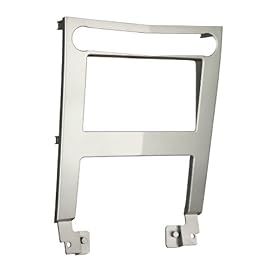
^^nice find thanks... musical taste differs... I listen to alot of Christian stuff, I listen to alot of podcast so thats the reason I need the Ipod hook up,but as far as music its hip-hop, and stuff like POD, Blindside, Skillet... so not one certain type, but those would be the main two... hip-hop and altern.
When a relatively low powered amplifier is driven into clipping (to the point of full square wave sometimes) the voltage delivered to the voice coil no longer resembles a sine wave because the amplifier clips the top and bottom of the wave off (because it's beyond what it can do). While this output is clipped (the flat spot on the top of the wave) the voice coil in your speaker is not moving but instead remains almost stationary at this time with high current still running through it. Because the voice coil is not moving it is not being cooled sufficiently (remember the coil is driven by a linear motor therefore the more voltage applied to the voice coil, the further it moves). In the image above you see that at points A, B, D, E, F and H the voltage is changing causing the voice coil to move in the gap and therefore pull in fresh cool air. At points C and G, the voice coil is still moving a little but this is only due to momentum. This is not enough to cool efficiently and there is still full current flowing through the voice coil. Since the displacement of the voice coil (and the relating airflow around it) is no longer proportional to the heat being generated, the voice coil will overheat. This excess heat (just as with overpowering) causes the voice coil to melt its insulation and the former to physically distort. Basically the whole motor burns apart as adhesives start to fail. However before you stress too much it should be noted that many reputable manufacturers underrate speakers so generally slight clipping isn't a problem. Severe clipping is more likely to cause a problem.
The second way to destroy a speaker is physically and this can also be broken down into two facets. The first physical facet is what we call bell mouthing. This is where the voice coil and former are driven so hard they actually extend beyond their normal range of motion and impact the back plate on the bottom of the speaker. This continual impacting causes the bottom of the voice coil to bend out like the bottom of a bell and this eventually cause the coil and corner to become so physically disfigured that it rubs on the magnet surrounding it and eventually comes to a complete halt. This isn't just restricted to subwoofers either. Tweeters playing frequencies that are too low tend to suffer from this phenomenon too because they're not designed for high excursion. The second facet of physically destroying a speaker is to punch way too much power into it fast and this causes what us engineering types like to call critical structure failure. That is a technical way of saying you'll simply tear the surround and/or spider(s) and pop the cone and motor assembly right off the frame. To 'blow the guts out of the speaker' is the more Aussie way of saying it. This is commonly witnessed during sound pressure level competition because the drivers are being pushed to their absolute limits.
The third and final way to destroy a speaker is an age old enemy of technology; sunlight. Nothing breaks down and erodes foam surrounds faster than sunlight (well except bugs like moths but you shouldn't have them living in your car). After only a few months of direct sunlight your speaker surrounds will be significantly weakened and may eventually begin cracking or simply tear all together. Butyl rubber surrounds are more resistant to sunlight but eventually all materials succumb to the mighty sun. The best thing to do with shelf speakers is place some grille cloth over the factory grilles. This helps in resisting ultra-violet rays from the sun penetrating through to the speaker.
These are the three main causes of most damaged speakers. The end result is the same with all three methods but you tend to get a lot more warning with thermal or sunlight damage. Physically speaking though; if you're pushing your speaker way beyond what its rating dictates you'll get very little warning before your speakers starts to smoke or literally explodes.
Note: The RMS voltage of a pure sine wave is equal to the peak voltage multiplied by 0.707. The RMS voltage of a pure square wave it equal to the peak voltage. For 2 waveforms with equal amplitude (as shown above), the RMS voltage of the square wave is 1.414 times the voltage of the sine wave. If we use the example of the 100 watt amp which can produce a sine wave of 20 volts RMS, we can see that the output power at hard clipping is double the power it can produce cleanly.
Sealed
Basically as far as sealed is concerned, the relationship between the characterisitics of the speaker being used and the volume of air inside the enclosure dictates the how well the sub will sound. When the enclosure is bigger, the air spring limits cone motion less and allows the system to play lower and with flatter overall response (lower Qtc) at the expense of power handling. Problem is if you go too large you start to compromise efficiency in order to gain the additional low frequency extension. On the other hand, making the enclosure smaller will cause the air spring to exert more control and limits cone motion at low frequencies which increases power handling but does not let the system play as low and produces a more peaked response (higher Qtc). For most half decent speakers there is a range of enclosure volumes that will produce high quality sound. Changing the enclosure volume within that range can fine-tune the sound to best suit the tastes of the listener. Of course other factors effect this but this is close enough.
Ported
Depending on the sound you desire, you tune a port to a certain frequency to achieve better bass response around that frequency. The tuning of the port there must be done using careful calculations which take into consideration the enclosure volume, the resonance of the port and the Thiele / Small parameters of the sub into consideration. Using these we attempt to delay the rear output wave of the speaker just enough so that when it comes out of the port it is close to being in phase with the wave being produced by the front of the sub. So with that in mind, you can see how, by altering the port length and diamter, we tuned the port to a certain frequency. The reason ported enclosures are generally considered louder is that when we utilise the work of the rear of the cone we gain double the bass, or 3dB over a broad range of frequencies. Again there are other things to consider and explain like the sub unloading below the port tuning but that is another thing...
Bandpass
With bandpass enclosures the woofer no longer plays directly into the listening area. Instead the entire output of the subwoofer system is produced through the port or series of ports. In a conventional sealed or ported enclosure the low-frequency extension is controlled by the interaction of the speaker and the enclosure design but the high frequency response is a result of the speaker's natural frequency response capability unless limited by a crossover. In a bandpass enclosure the front of the speaker fires into a chamber which is tuned by a port. This ported front chamber acts as a low-pass filter which acoustically limits the high frequency response of the subwoofer system. The name "bandpass" is really pretty descriptive in that it refers to the fact that the enclosure will only allow a certain frequency "band" to "pass" into the listening environment.
Where to mount them then? Kick panels, sails or elsewhere?
We often see tweeters mounted up high on the sail area on the door or down in the kick panels. Both these work well but can suffer from similar issues. The problem with the sail mounts is this; think about the position of your ears in relation to the tweeters. One speaker is belting the high pitch tunes out about one foot from your ear where as the other tweeter is triple, quadruple or quintuple that distance away. The image has no choice but to be right out the side window. Sheer laws of physics govern this fact.
What about time alignment?
Time alignment is an essential tool but it can also be a curse if not used correctly. One of the more common problems associated with time alignment is regarding the seperate sides of the car in relation to stage width. If you're not careful, the better you make one side sound (and you can get it absolutely perfect) the more the other will suffer. This is because you're delaying one speaker side so both signal paths reach your ears at the same time. The problem with this is that the other side has the reverse problem to your side so as yours gets better, it can get worse. However when used correctly (and we recommend you do use time alignment) it can move the stage depth forwards (you delay the fronts in relation to the subwoofer too) in addition to getting your image perfectly located in the center. With a careful blend of experimentation and measuring you will eventually get both sides sounding great.
So how does one get the stage right in real world terms?
At the end of the day you'll just have to experiment quite a bit (and sometimes it can take days) to get the tweeter placement just right to achieve the perfect stage 'width', 'height' and 'depth'. Get yourself a nice big blob of blue-tac. Stick the tweeter onto a panel somewhere, turn the time alignment off for the moment and commence playing songs performed by a powerful vocalist (ranging from baritone up to contralto as these are the frequencies at which human hearing is most sensitive and therefore is best for staging). Close your eyes and imagine you're at the concert. Now listen to where the singer is coming from. Are they singing from right in front of you? Are they slightly off to the left a tad or right? Are they a little high or a little low? Simple move the tweeter a few inches in a direction and have another listen. How is the image? Can you hear where all the band members are exactly? How is the depth? Does the drummer sound like he is behind the other musicians (stage depth)? Do the individual musicians sound like they are specifically somewhere on the stage? (stage width). Keep doing this until you get the image dead center but remember to take a rest every fifteen minutes for half an hour to let your ears normalize. Remember your ear drums are controlled by muscles and they (just like any other muscle) get tired, so make sure you give them a rest. If you attempt staging for hours on end your ears tend to 'hallucinate' and give false readings. Once you have it very close then you can activate your time alignment and do the fine tuning.
Advanced staging and imaging techniques
If you're really serious about getting your stage and image the best it can possibly be then you should also consider the manufacture of new panels altogether. That way you can physically change the location of the tweeter (in the case of a two way component set) or midrange and tweeter (in the case of a three way component set). Below are some of the options for different tweeter and midrange mounting locations.
But I have heard so many conflicting opinions…
Now you might have heard hi-fi buffs recommending against using 6x9's in high end audio systems whilst recommending them for every other type of system. There are actually numerous pro's and con's of 6x9's and there are reasons why they're avoided for high budget systems and targeted for low budget systems and factory upgrades.
Lets look at the cons first.
The first issue is the actual cone size. The large woofer cone is a different width to length so it is obviously uneven. When viewed under a microscope the woofer cone can physically distort quite dramatically and hence, disastrously so far as sound quality is concerned. They tend to distort more than round or square speakers where kinetic forces are evenly exerted across the cone surface. Another big problem faced by 6x9's is one similarly faced by co-axials. The woofer is seated directly underneath the midrange and tweeter. While this doesn't bother the average tweeter because they're sealed in most cases, it can cause great stress and problems for the midrange which is trying to play a higher frequency than the pounding a woofer underneath. More often than not midrange clarity tends to suffer and can sound blurred as the woofer underneath wins every time. Simply put, 6x9s are not dedicated drivers. They do not offer the same freedom for fine tuning nor do they faithfully reproduce sound like separate components do. They do their job competently but will never match a separate subwoofer for bass reproduction, or separate woofer for mid-bass reproduction or tweeter for high end reproduction because these drivers are dedicated to reproducing their own little part of the sound spectrum and they do it well. Components can also be mounted separately to help with staging and imaging.
But they must have some pro's.
They do. As stated above the cone on a 6x9 is exactly that, which incidentally is nearly the same surface area as an 8" subwoofer. With their relatively high power handling, the 6x9 can punch out quite a bit of bass and they can even be run in enclosures to enhance this ability. Another big bonus of the 6x9 is their power handling ability and efficiency. They can be run off the smallest internal (head unit) amplifier to the largest external units. Because of this ability they make terrific upgrades to factory systems where a little more bass is required. On that note, they will also fit into many factory locations without the need to cut anything up.
Damping Factor
Damping factor describes an amplifiers ability to control a woofer cone. It's the ratio of rated load impedance to the internal impedance of an amplifier. The higher the damping factor the more efficiently an amplifier can control unwanted movement of the speaker coil. High damping factor is crucial for subwoofers and the higher the damping factor the better. It is debatable if anything over 50 is audible. Damping factor is calculated by dividing the speaker impedance by the output impedance of the amplifier. In other words the damping factor will decrease as the speakers impedance decreases. This means an amp optimised at 4 ohms will provide tighter bass than when they're running at 2 ohms. A lower damping factor will leave bass notes sounding soft and undefined, regardless of the amplifiers power output. You can see by this that a smaller 100 watt amplifier with a high damping factor can often sound better than one twice it's size with a low damping factor.
Slew Rate
Sometimes referred to as damping factor for tweeters, the slew rate describes the amplifiers ability to accurately control fast direction changes of a speaker cone or dome. Have you even turned your stereo up to discover that your cymbals sound like someone throwing a brick through a glass window? That's because the amplifier simply wasn't fast enough to accurately reproduce the high frequency ring of the symbols. Measured in volts per microsecond, a low slew rate softens the definition of a sound signal which blurs transients and causes the sound to appear muddy. A high slew rate means the amp responses faster which ultimately results in crystal clear highs.
Total harmonic distortion
THD is the measurement of the how much the amplifier can distort the sound signal through the introduction of added harmonics or overtones. THD figures are usually given as percentages and a THD figure below 1% are generally inaudible to most people. However, distortion is a cumulative phenomenon so if your head unit, eq, crossover and amplifier are all rated at less than 1%THD each, together they could produce 5%THD which may well be noticeable to most of you.
Signal to noise ratio
Noise leaking into the sound signal is an ever present problem in car audio. The Signal to noise ratio is a measurement of noise level in the amplifier compared to the level of the signal. A higher S/N ratio signifies a greater difference which is better. Technically speaking, it's the ratio expressed in dB of signal power at a reference point in a circuit to the noise information that would exist if the signal were removed (the noise floor). The maximum signal to noise ratio of the amp can be seen as a measure of realistic fidelity. This ratio is how much absolute noise it produces compared to the highest signal voltage it can pass without distortion. Many companies combat noise by utilising balanced line systems.
Stereo separation.
Separation is not spoken about much but this refers to the amplifiers ability to maintain the separation between the right and left channels. This is essentially what allows an amplifier to reproduce an accurate sound stage. Each individual instrument is after all, are recorded in it's own location in the sound stage and you should be able to hear this in the same way when it's played in your car.
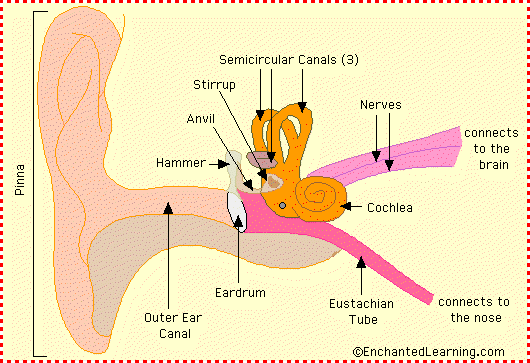
When speakers move backwards and forwards they do so many times a second. Each time the cone does one complete movement forward then backwards then back to the zero point it's known as a cycle or one hertz (a.k.a. 1Hz). If the speaker undertakes one thousand of these cycles per second it is known to be playing 1000 hertz or 1 kilohertz (a.k.a. 1000Hz or 1kHz respectively). Music is the repeating pattern of these high and low pressure regions in various frequency orders and certain patterns of frequencies our ears interpret as harmonious. This harmony is simply the music you're listening too. The Pinna (the outer ear skin section) catches these waves and directs them into our ear canal which houses our ear drum. The ear drum then mimics these varying pressure waves and lets your brain know what its hearing.
Now you understand the basics of how sound physically works so let us move to the sound deadening itself. As speakers move in alternating directions the sound emanates from both the front and rear of the cone. The front wave is heard by you while the rear wave is what the sound deadening and diffusers deals with. With all due respect; your cars doors are glorified metal cans. They echo and reverberate inside and the skins flex easily, causing bass to become blurred and muddy and even to cancel itself out all together. I usually explain it by using the following analogy. Imagine you're seated in a boat in the middle of a crystal clear flat lake. One hundred meters away there is another boat floating idle. If you start gently rocking you boat, waves emanate from it. Pretty soon these waves reach the second boat and it also begins bobbing to mimic these waves. The problem is that as this second boat rocks it not only reflects your waves back but also creates its own. Your doors are the same in that the metal skins flex and create all matter of sound effects. These waves are only minutes or seconds out of phase (i.e. not even whole degrees) to the active wave and the result is that your ears get bombarded by literally hundreds of sound waves that are not supposed to be there. This creates an echoic effect and the end result is that the music sounds hollow and tinny. By adding sound deadening you're adding mass to the doors skins (like swapping the second boat for a cement pier in our analogy). This combats flexing its effects on internal sound waves.
Diffusers are absorbent pads that resemble foam or tiny egg cartons. These fight wave reflections and are placed directly behind the speaker. Remembering back to our boat analogy with the cement pier (deadening) now in place; while extra waves are not being created any more, the main waves will still be reflected. This is where the diffusers come in. We know from above that sound waves have a certain lengths at any given frequency. Somewhere within these frequencies is the perfect distance for sound emanating from the rear of the speaker cone to travel to the doors outer skin. This will then reflect and come flying back to impact the cone and cancel the next cycle. The diffusers catch these sound waves and trap them much the same way that the paint on stealth aircraft catches radar waves or submarines rubber skin traps sonar waves. The reason you need diffusers on top of the deadening is that most sound deadening has a smooth skin and hence still reflects sound waves.
Another vitally important aspect of achieving good midbass is to seal the speaker into the door. In nature all elements take the easiest path from origin to destination. Water is a good example of this phenomenon; you pour it out and it will run wherever the easiest path is. Air is the same. When your speaker cone moves forward, it creates a high pressure cell right in front of the speaker cone. If there is a high pressure cell in front of the cone then there will be a low pressure cell on the rear side of the speaker cone. If the door is fully sound deadened and the speaker is sealed on using sealant of foam gasket, the high pressure air will move out towards you with the end result being incredibly punchy and tight midbass from your doors. If there is no sealing (say the speaker is simply screwed down to the metal) and contains air leaks everywhere, the high pressure air simply takes the easiest path and moves around the edge of the speaker frame to behind the speaker where the low pressure cell is. In simple terms, you get no bass.
Many cars come with deadening from the factory but it is usually an insufficient amount, often only being a few inches here and there to minimise rattles during transit. Car manufacturers limit this deadening in order to keep production costs down. How much deadening you end up installing depends on your budget but both the inner and outer skin of your front doors should be fully deadened at least. You can always add more to the boot, floor and roof down the track.
In conclusion; for the serious sound enthusiast sound deadening is an absolute must. If you have a close look you'll notice the cars that sound the best in every continent (especially the ones that win the sound offs) are chock full of deadening. Sound deadening even helps factory speakers so get your self some today. http://
From what you have read above you can now see why many demo and competition cars have their rear speakers turned down or simply don't have them at all. What we instead recommend is that you spend all your money on the front speakers where you are and get yourself some sound deadening (q.v.). http://
hey monday im gonna stay with the 2 sundown sa 12s like you said just gonna save up haha but are the sites soundsoloutionsaudio.com, sonicelectronix.com andonlinecarstereo.com cool to buy off of? and so do you have to have some of that sound deadening
hey monday im gonna stay with the 2 sundown sa 12s like you said just gonna save up haha but are the sites soundsoloutionsaudio.com, sonicelectronix.com and onlinecarstereo.com cool to buy off of? and so do you have to have some of that sound deadening