Black Culture Discussion Thread

Memory Lane: 1994 Violent Crime Control Act

ap9409130391_wide-570b21ff250e994b1ceda5fcedd1254d842b5988-s800-c85.jpg


The Violent Crime Control and Law Enforcement Act was passed with bi-partisan support in April 1994 and was originally written by another familiar politician: then-Sen. Joe Biden.

The crime bill was one of the largest in the country's history, with multiple initiatives to fight crime, and it came at a time when violent crime was at staggering heights. According to the the FBI, there were more than 713 violent crimes per 100,000 people in 1994. In context, that is the second-highest annual crime rate from 1993 until 2012, with 1993 having the highest violent crime rate of 747 per 100,000 residents.

Notably, the law helped pay for new federal prisons if states agreed to force offenders to serve 85 percent of their sentence as opposed to allowing them out early on parole.

"It looked on the books as if this was going to more than double the prison sentence lengths of offenders nationwide if the individual states would go for it," Professor Candace McCoy from John Jay College's Doctoral Program in Criminal Justice told ABC News.

"In actual impact, that law was considerably less severe than it appeared and that's because many states didn't go for it. The ones that did, such as New Jersey ... they applied it only to violent offenders. Well, most of those people were going to prison for very long times anyway so it increased the sentence lengths sometimes, but not much. They virtually abolished parole," she added.

One of the other more visible initiatives was the hiring of 100,000 more police officers across the country by paying for two-thirds of the new officers' salaries in participating cities.

"The idea behind this whole thing is it enabled the police to do their job more effectively," said former NYPD Sgt. Joe Giacalone, who joined the force in 1992.

There were many other facets to the law, but some of the most notable others are the creation of the federal "three strikes" rule, which mandated life in prison for people who had committed three violent felonies; the assault weapons ban, which stopped the manufacture of 19 semi-automatic firearms; and the removal of education grants for inmates.

The law is largely criticized for causing incarceration rates to spike, particularly for minorities. But experts differ on the direct impact the crime bill had on mass incarceration.
 
D.C. Is Being Sued For Gentrifying. Here's What To Know About The Case http://dcist.com/2018/06/dc_is_being_sued_for_gentrifying_he.php via @DCist

A D.C. lawyer has filed a discrimination lawsuit against the city on behalf of three native Washingtonians and CARE, a community group with over 20 members. The suit claims that the city’s housing and urban renewal policies have discriminated against some of the District’s longest-standing residents in favor of attracting millennial renters. The suit is seeking more than $1 billion in damages.

So, what exactly does it allege?

The complaint points specifically to city policies like the Adrian Fenty Administration’s Creative Action Agenda and Vincent Gray’s Creative Economy Strategy, which are specifically geared toward remaking D.C. as a city for “creative” workers. According to Aristotle Theresa, the lawyer who filed the suit, the city’s successful attempts to attract these kinds of workers have come at the cost of D.C.’s low and middle-income African American families, who have been pushed out of the city by skyrocketing housing prices.

“The city is intentionally trying to lighten black neighborhoods, and the way they have primarily been doing it is through construction of high density, luxury buildings, that primarily only offer studios and one bedrooms,” the suit reads.

Many of D.C.’s policies—like the policies of large cities across the country in the mid-aughts—were based on the work of Richard Florida, an influential urban theorist who wrote the seminal text on the “creative class.” His 2002 book The Rise of the Creative Class describes a specific kind of worker, often young and working in fields like technology, science, art and journalism. According to his theory, the key to a successful city economy lies in the hands of these workers, who have very particular ideas about where and how they want to live.

“Creatives prefer indigenous street level culture—a teeming blend of cafes and sidewalk musicians and small galleries and bistros, where it is hard to draw the line between performers and spectators,” Florida once wrote.

According to the complaint, former Mayor Adrian Fenty’s administration set about creating such an environment to attract these workers, and the two administrations since have kept it going. Theresa says these policies have been directly discriminatory on the basis of age and source of income, as well as having a disparate impact on the city’s African-American communities.

“D.C. residents’ access to rental property [is] predicated at least in part on membership in an invented discrete class which directly discriminates on source of income,” he writes in the complaint.

The suit names several defendants, including the Office of Planning, the Zoning Commission, the Deputy Mayor for Economic Development, Mayor Muriel Bowser and former Mayor Adrian Fenty.

What does the city say?

Nothing so far. A response to the suit is due by June 25. The Attorney General’s Office told the Washington Post that it won’t comment on pending litigation. The Zoning Commission and the mayor’s office told DCist the same thing.

Who's filing the suit?

Aristotle Theresa is a D.C. civil rights lawyer who lives in Anacostia. He’s represented several D.C. residents and community groups in cases fighting big redevelopment projects in gentrifying neighborhoods. He was most recently involved in the Barry Farm case, in which residents of the public housing complex successfully sued the D.C. Housing Authority for the way it was handling redevelopment. The area is being razed and rebuilt with many new (and more expensive) units, meant to economically integrate the area. Residents have been afraid of they would end up getting evicted from the complex and left without housing.

Theresa is filing the suit on behalf of three African American women who say they’re fearful of getting pushed out of the city due to redevelopment and climbing housing costs. He is also filing on behalf of a community group of more than 20 members. Theresa says they are seeking class certification for the lawsuit.

Does this stand a chance in court?

It’s hard to tell. Several times in the complaint, Theresa says that the city is “intentionally” discriminating against people based on age and source of income. This intentionality may be difficult to prove in court. Anthony Cook, a professor at Georgetown Law, says that discrimination based on source of income generally refers to landlords refusing to rent to people who use housing vouchers. The issue of whether one is in the creative class as a basis for discrimination likely won’t have a leg to stand on in court, he says.

However, Cook adds that Theresa might be able to make an argument about disparate impact—that is, the idea that city policies have had negative outcomes for certain populations, even if the city did not directly intend to discriminate.

“You can sustain a claim with regard to disparate impact under the law. It’s not just about whether the city intends to discriminate,” Cook says.

Any other context?

It’s common knowledge by now that the District has rapidly gentrified since the early 2000s. According to an analysis by Governing Magazine, 52 percent of D.C.’s census tracts are categorized as “gentrifying” since that time. The city has been bleeding black residents in that process. The lawsuit arises from that context—Theresa says that since he was a child growing up in D.C., he has believed the city is actively trying to get rid of its African American residents.

“I think [gentrification] is problematic because it strips away the heart and soul of the city,” Theresa says. “D.C. is unrecognizable. It’s a staging ground for people at a certain point in their career. It’s a pitstop, and they come and they go and they don’t offer much,” he says.

This story has been updated to reflect that the suit was filed on behalf of three people and a community group of more than 20 members.
 
The idea makes me reminisce of the times i used to go to GoGo's.

Aint watch the vid.

Bout to listen to mambo sauce (New age gogo)
 
Last edited:
Black Business Owner Refuses to Sell Out; Turned Down 3 Million Dollar Offer


https://www.austinchronicle.com/food/2018-06-15/sams-bar-b-que-is-open-for-now/

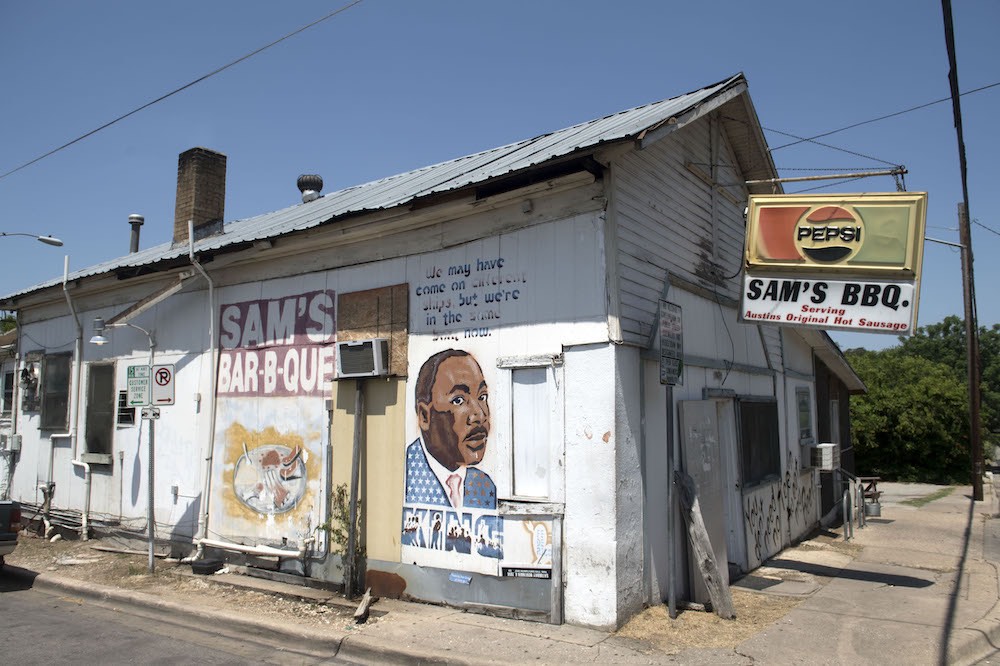
Despite concerns from longtime patrons, Sam’s Bar-B-Que on E. 12th remains open for business. The news comes as a relief to many because this iconic spot has been serving the Eastside, and the rest of Austin, homestyle barbecue for more than six decades.

Still, current owner Brian Mays, who inherited the restaurant from his father, Dan, warned the Chronicle this week that while he is committed to keeping Sam’s Bar-B-Que open, he’s also fielding increasingly rich offers on the highly coveted 12th Street lot. In fact, Mays explains that developers recently offered him $3 million so they could demolish it and put an apartment building topped with condos on the site.

The outside wall of the small white building features a painted bust of Martin Luther King Jr.; the inside houses the brick pit, seasoned for decades, where they slow-smoke meats from beef to mutton. Sam Campbell opened his eponymous restaurant in 1957, and when he died in 1976, the Mays family took over, maintaining the focus on good food and good community ever since.

food_feature6.jpg

Photo by John Anderson

It’s that very sense of community that keeps the doors of Sam’s Bar-B-Que open. Mays says a major reason he turns down the offers is because people in the neighborhood plead with him to stay open. Sam’s is a stalwart in a rapidly changing area where many beloved black-owned businesses have already closed. But with developers from Dallas to California regularly calling Mays, it’s not much of a stretch to imagine another offer coming along in the near future. And next time, it might simply be one that’s too good to pass up.

“I just turned down $3 million for the community,” Mays said. “I told them, ‘I don’t mind staying, but I turned down $3 million. I need support now.’ I’m going to be here, but y’all have got to support me now.”
 
Important to note though how crazy violent crime was in that era, and the Bill had black support

http://www.slate.com/articles/news_...ed_the_1994_crime_bill_championed_by_the.html


Everyone missed it on that one. Well intentioned, but lacked proper analysis and foresight. But if we're forever holding Hillary accountable to that, we should do the same for the black leaders as well.

Of course a white dude wrote that. :lol

It's funny how them people, even the almighty president listens to black leaders when they want something to punish us but when leaders are asking to stop police brutality, better school systems, jobs, resources the government and president acts like their hands are tied.
 
I see all the politicians
And everyone talking about
How wrong it is to separate these families at the border
And all this
And I totally agree
But why they ain’t keep that same energy
When/while are unarmed black folks was getting shot down like dogs
It irritates me
 
I see all the politicians
And everyone talking about
How wrong it is to separate these families at the border
And all this
And I totally agree
But why they ain’t keep that same energy
When/while are unarmed black folks was getting shot down like dogs
It irritates me

i saw that same energy, where were you looking?

granted, nothing changed...but the energy you claim wasnt there was.
 
Of course a white dude wrote that. :lol:

It's funny how them people, even the almighty president listens to black leaders when they want something to punish us but when leaders are asking to stop police brutality, better school systems, jobs, resources the government and president acts like their hands are tied.

"Spoke to the top gang, thug leaders...Gotta get that body count down."

WEB-Reuters-Donald-Trump-Darrell-Scott_.jpg
 
Happy Juneteenth y'all.

This post by Clint Smith really puts things in perspective for me. The horrible remnants of slavery continue to well beyond Juneteenth.

Imagine being separated from your family members and never seeing them again and having no way of finding them.:smh::smile::smile:

Informationwanted.org has over 3,000 such letters and stories. It's truly heartbreaking stuff.


Last edited:
Happy Juneteenth y'all.

This post by Clint Smith really puts things in perspective for me. The horrible remnants of slavery continue to well beyond Juneteenth.

Imagine being separated from your family members and never seeing them again and having no way of finding them.:smh::smile::smile:


whats getting to me is them referring to themselves as property
and being owned and sold :{


Dr. Frances Cress Welsing, in the 'Isis Papers,' talked about how the gun, to the white supremacist, is a representation of the black male penis (The great equalizer)




Last edited:
Back
Top Bottom