- Jan 11, 2013
- 18,115
- 11,771
Follow along with the video below to see how to install our site as a web app on your home screen.
Note: This feature may not be available in some browsers.


The Violent Crime Control and Law Enforcement Act was passed with bi-partisan support in April 1994 and was originally written by another familiar politician: then-Sen. Joe Biden.
The crime bill was one of the largest in the country's history, with multiple initiatives to fight crime, and it came at a time when violent crime was at staggering heights. According to the the FBI, there were more than 713 violent crimes per 100,000 people in 1994. In context, that is the second-highest annual crime rate from 1993 until 2012, with 1993 having the highest violent crime rate of 747 per 100,000 residents.
Notably, the law helped pay for new federal prisons if states agreed to force offenders to serve 85 percent of their sentence as opposed to allowing them out early on parole.
"It looked on the books as if this was going to more than double the prison sentence lengths of offenders nationwide if the individual states would go for it," Professor Candace McCoy from John Jay College's Doctoral Program in Criminal Justice told ABC News.
"In actual impact, that law was considerably less severe than it appeared and that's because many states didn't go for it. The ones that did, such as New Jersey ... they applied it only to violent offenders. Well, most of those people were going to prison for very long times anyway so it increased the sentence lengths sometimes, but not much. They virtually abolished parole," she added.
One of the other more visible initiatives was the hiring of 100,000 more police officers across the country by paying for two-thirds of the new officers' salaries in participating cities.
"The idea behind this whole thing is it enabled the police to do their job more effectively," said former NYPD Sgt. Joe Giacalone, who joined the force in 1992.
There were many other facets to the law, but some of the most notable others are the creation of the federal "three strikes" rule, which mandated life in prison for people who had committed three violent felonies; the assault weapons ban, which stopped the manufacture of 19 semi-automatic firearms; and the removal of education grants for inmates.
The law is largely criticized for causing incarceration rates to spike, particularly for minorities. But experts differ on the direct impact the crime bill had on mass incarceration.



this dude took home the 360 belt

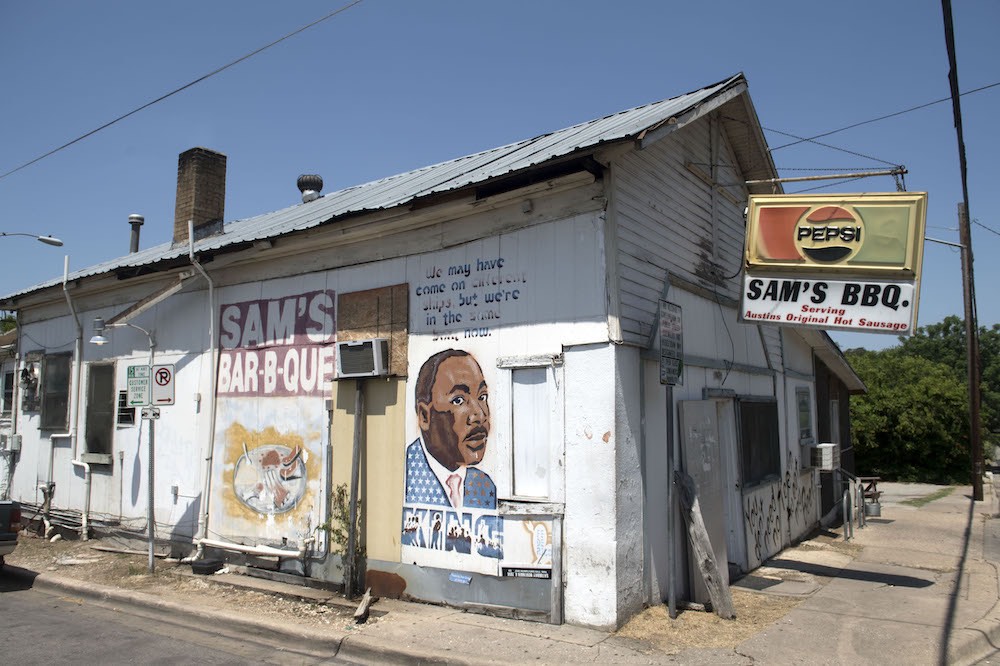
Despite concerns from longtime patrons, Sam’s Bar-B-Que on E. 12th remains open for business. The news comes as a relief to many because this iconic spot has been serving the Eastside, and the rest of Austin, homestyle barbecue for more than six decades.
Still, current owner Brian Mays, who inherited the restaurant from his father, Dan, warned the Chronicle this week that while he is committed to keeping Sam’s Bar-B-Que open, he’s also fielding increasingly rich offers on the highly coveted 12th Street lot. In fact, Mays explains that developers recently offered him $3 million so they could demolish it and put an apartment building topped with condos on the site.
The outside wall of the small white building features a painted bust of Martin Luther King Jr.; the inside houses the brick pit, seasoned for decades, where they slow-smoke meats from beef to mutton. Sam Campbell opened his eponymous restaurant in 1957, and when he died in 1976, the Mays family took over, maintaining the focus on good food and good community ever since.

Photo by John Anderson
It’s that very sense of community that keeps the doors of Sam’s Bar-B-Que open. Mays says a major reason he turns down the offers is because people in the neighborhood plead with him to stay open. Sam’s is a stalwart in a rapidly changing area where many beloved black-owned businesses have already closed. But with developers from Dallas to California regularly calling Mays, it’s not much of a stretch to imagine another offer coming along in the near future. And next time, it might simply be one that’s too good to pass up.
“I just turned down $3 million for the community,” Mays said. “I told them, ‘I don’t mind staying, but I turned down $3 million. I need support now.’ I’m going to be here, but y’all have got to support me now.”

Important to note though how crazy violent crime was in that era, and the Bill had black support
http://www.slate.com/articles/news_...ed_the_1994_crime_bill_championed_by_the.html
Everyone missed it on that one. Well intentioned, but lacked proper analysis and foresight. But if we're forever holding Hillary accountable to that, we should do the same for the black leaders as well.


I see all the politicians
And everyone talking about
How wrong it is to separate these families at the border
And all this
And I totally agree
But why they ain’t keep that same energy
When/while are unarmed black folks was getting shot down like dogs
It irritates me
Of course a white dude wrote that.
It's funny how them people, even the almighty president listens to black leaders when they want something to punish us but when leaders are asking to stop police brutality, better school systems, jobs, resources the government and president acts like their hands are tied.

NAHi saw that same energy, where were you looking?
granted, nothing changed...but the energy you claim wasnt there was.
serious question"Spoke to the top gang, thug leaders...Gotta get that body count down."
serious question
isnt that brian pumper
Pastor Darrell Scott. One of Trumps "what about black on black crime" buscuit boys.


Happy Juneteenth y'all.
This post by Clint Smith really puts things in perspective for me. The horrible remnants of slavery continue to well beyond Juneteenth.
Imagine being separated from your family members and never seeing them again and having no way of finding them.
Classic Tariq roast"Spoke to the top gang, thug leaders...Gotta get that body count down."
Dawgserious question
isnt that brian pumper
Dr. Frances Cress Welsing, in the 'Isis Papers,' talked about how the gun, to the white supremacist, is a representation of the black male penis (The great equalizer)